Basement Floor Epoxy: The Complete Guide
Basement floor epoxy is the same coating that goes on a garage floor, put down in a room that is below grade, closed in and lived in. Those three things change the job: the slab is damper, the air does not move, and the finish gets looked at from a couch instead of a car. This guide covers what to check, which kit to use, how much it costs and how to do it. The kit built for it is the Basement & Indoor Pro System; everything for below-grade floors is in basement floor epoxy kits.
Can you epoxy a basement floor?
Yes, if three things are true:
- The slab is dry, or you prime for moisture. Moisture vapor coming up through a below-grade slab is the reason most basement coatings lift. It is handled with a moisture vapor primer. Liquid water is different; see the next point.
- Water is not coming in. No coating stops water that enters through the walls, the cove joint or the slab after rain. If the basement gets wet, fix the drainage, grading or sump first. A coating over an active leak will blister.
- The concrete can be ground. Paint, sealer, tile mastic and carpet glue all have to come off, and the bare concrete has to be profiled. If the slab is covered in something you cannot remove, call us before you buy anything.
Step 1: the moisture test, done right
Tape a 2 ft square of plastic sheeting to the bare slab and seal all four edges. Leave it 24 hours, 48 if you can. Darkened concrete, droplets or fog under the plastic means the slab is pushing moisture. Do more than one spot in a basement: the corner by the foundation wall, the middle of the room, and anywhere near the sump or a floor drain.
- Passed everywhere: no primer. The base coat goes straight onto the ground concrete.
- Failed anywhere: roll P-409 Moisture Vapor Primer over the whole floor before the base coat. One 1.5 gal kit covers about 140 sq ft, so a 700 sq ft basement takes the 3 gal kit plus a 1.5 gal kit. P-409 is not in the Basement Pro kit because many slabs do not need it. Add it to the order if yours does.
Older houses, slabs with no vapor barrier under them, and finished basements that have had a damp smell are the usual failures. More in how to test a concrete floor for moisture.
Step 2: choose the kit and the finish
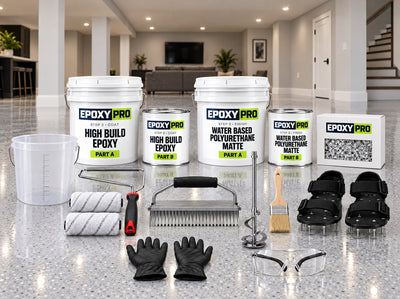
The Basement & Indoor Pro System is the Garage Pro floor sized by square feet, with a matte, low-odor water-based topcoat instead of the gloss garage topcoat. It comes in three finishes:
| Finish | What you get | Best for | Up to 700 sq ft |
|---|---|---|---|
| Solid color | B-707 100% solids epoxy at about 14 mils, T-520 matte polyurethane on top | The lowest price and the lowest odor. Shows flaws in the slab. | $1,224.99 |
| Full flake | B-707, a full flake broadcast, T-444X polyaspartic clear | Older slabs. Flake hides patches, stains and texture, and gives grip. | $1,694.99 |
| Metallic | Black ground coat, pigmented clear epoxy, T-520 matte | A finished living space with a slab in good shape | $1,694.99 |
Twelve solid colors, ten flake blends and thirteen metallics are on the epoxy floor colors page. Lighter colors brighten a basement; medium grays and flake hide the most.
Why the matte topcoat
A glossy floor under basement lighting shows every roller mark, scuff and footprint. T-520 is a satin-matte water-based polyurethane: it reads as a finished floor, it hides wear, and it is under 50 g/L VOC. The B-707 base coat under it is under 2 g/L VOC. That combination is why the solid color basement kit can go down in an occupied house with the windows open.
What about a garage kit in the basement?
It works, but the gloss topcoat is the wrong look indoors and the Pro garage topcoat is a higher-VOC product. Use the basement kit for any room people live in.
Step 3: size it
Measure each room, length times width, and add them up. Closets and under-stair areas count if you are coating them. The kit sizes are up to 350, 700, 1,050, 1,400, 1,750 and 2,100 sq ft. A 22 by 30 ft basement is 660 sq ft and takes the 700. If you are near the top of a size, go up; old slabs are porous and drink more. The epoxy calculator sizes it from your measurements.
What a basement epoxy floor costs
| Floor size | Solid color | Full flake | Metallic |
|---|---|---|---|
| Up to 350 sq ft | $679.99 ($1.94 per sq ft) | $904.99 ($2.59) | $909.99 ($2.60) |
| Up to 700 sq ft | $1,224.99 ($1.75) | $1,694.99 ($2.42) | $1,694.99 ($2.42) |
| Up to 1,050 sq ft | $1,789.99 ($1.70) | $2,489.99 ($2.37) | $2,499.99 ($2.38) |
| Up to 1,400 sq ft | $2,444.99 ($1.75) | $3,389.99 ($2.42) | $3,284.99 ($2.35) |
| Up to 1,750 sq ft | $3,014.99 ($1.72) | $4,184.99 ($2.39) | $4,089.99 ($2.34) |
| Up to 2,100 sq ft | $3,559.99 ($1.70) | $4,974.99 ($2.37) | $4,869.99 ($2.32) |
Topcoat and tools are included. Add P-409 if the slab is damp ($194.99 per 1.5 gal kit), crack filler if needed ($99.99 for the 1 gal kit that does most basements), and a day of grinder rental. Orders over $500 ship free. Installed, a basement epoxy floor runs $6 to $9 per sq ft, more where access is tight. Done yourself, it costs less per square foot than vinyl plank, tile or carpet, and unlike carpet or laminate it does not have to be torn out if the basement takes on water once.
Step 4: prep
Everything in how to prep a basement floor for epoxy, plus what basements add:
- Get the old floor off. Carpet tack strips, glue, tile mastic and paint all have to be ground away. Rent a grinder with a vacuum port and ask for the aggressive cup wheel if there is glue. Mastic from before 1980 can contain asbestos; have it tested before you grind it.
- Ventilate while grinding. Put a box fan in a window blowing out and open a door upstairs. Concrete dust in a closed basement goes everywhere.
- Repair. Cracks: R-818 Epoxy Crack Filler. Chips and spalls: R-343 Concrete Quick Fix. The joint between slab and wall usually stays open; it is a drainage path in many basements, so do not fill it with a rigid product.
- Floor drains and the sump. Tape them off. Coat up to the edge, not into them.
- Temperature. Slab and air between 60 and 90°F. Basements run cool; run a space heater for a day before so the slab itself comes up to temperature, and keep it running through the cure. Below 60°F epoxy stays soft for a long time.
- Vacuum twice, including the edges and the stair treads above the floor, so dust does not drop onto the wet coat.
Step 5: coat
The sequence is the same as a garage; the detailed walkthrough is in how to epoxy a garage floor.
- Day one. Prime with P-409 if the slab failed the moisture test, then roll B-707 (same day if the primer is tack free, otherwise the next morning). Broadcast flake into the wet epoxy if you chose flake. Start at the far wall and finish at the stairs.
- Day two. Scrape and vacuum loose flake, then roll the topcoat thin: T-520 matte on solid and metallic floors, T-444X clear on flake. Keep a fan moving air through the basement, especially for the polyaspartic clear, which has more odor than the water-based matte.
- Day three. Walk on it. Furniture after day four to seven. Put felt under anything heavy.
Work from the far corner toward the stairs so you are never trapped on wet floor, and give yourself an escape path if the stairs land in the middle of the room.
Odor and living in the house while it cures
- B-707 is 100% solids and under 2 g/L VOC, so there is little smell from the base coat. T-520 is water-based and low odor. A solid color basement floor can be done with the family upstairs and the windows open.
- The polyaspartic clear on a flake floor has a stronger odor for a day. Ventilate hard and keep the basement door closed.
- Keep every coating away from a furnace or water heater pilot light; shut them off while you coat solvent products. Details in how long the epoxy smell takes to go away.
Basement floor epoxy problems and how to avoid them
- Bubbles or blisters a month later. Moisture vapor pushing up. The slab needed P-409. Fix: grind the blisters, prime, recoat the area.
- White haze or peeling along the walls. Water is entering at the cove joint. That is a drainage problem, not a coating problem.
- Soft, rubbery coating. The slab was below 60°F. Heat the room and give it a week.
- Roller marks and shiny patches. Topcoat rolled too thick or overworked. Roll thin from a tray, one direction.
- Peeling in sheets. Coated over sealer, paint or glue. Nothing bonds to those. Grind to bare concrete.
More on failures in why epoxy floors peel and how to fix one.
Basement floor epoxy FAQ
Is epoxy good for a basement floor?
Yes. It is seamless, it does not absorb water or hold mildew, it cleans with a mop, and with a moisture primer it handles vapor from below. It is the floor that survives a wet basement.
Does epoxy make a basement floor waterproof?
It makes the surface waterproof from above and, with P-409, it blocks vapor from below. It does not stop liquid water entering under pressure, and it is not a substitute for drainage.
Will epoxy trap moisture and damage the slab?
A properly primed epoxy floor does not damage concrete. The risk runs the other way: moisture that cannot escape lifts an unprimed coating. That is what the moisture test and P-409 are for.
Can I epoxy over basement floor paint?
No. Grind it off. Paint is the weakest layer and the epoxy will peel with it.
Can I epoxy over tile or a wood subfloor in the basement?
Different systems. See can you epoxy over tile and can you epoxy over wood or plywood.
Is epoxy slippery for a playroom or gym?
A full flake floor has texture. A solid color or metallic floor is smooth; stir anti-slip grit into the topcoat where it matters. Rubber gym tiles go down fine on top of an epoxy floor.
How long does a basement epoxy floor last?
Longer than the same floor in a garage, because there are no hot tires, no UV and no road salt. A properly prepped and primed basement floor is a decades-long floor. See how long epoxy coatings last.
Basements are the floors we most often talk people out of coating until a leak is fixed, and the ones that turn out best once it is. Every order includes a free 20-minute consultation. Call (877) 703-7699. If we miss you, we call back within an hour.
 How to Prep a Basement Floor for Epoxy